
What are the UK student visa financial requirements?
The financial requirement is proof that you can pay for your course and support yourself in the UK. You must show two things:
- Course fees — enough to pay the fees for your first academic year (up to nine months). The amount still owed is shown on your Confirmation of Acceptance for Studies (CAS).
- Living costs (“maintenance”) — a fixed monthly amount for each month of your course, up to a maximum of nine months. The rate depends on whether you study in London or elsewhere.
“London” means the City of London and the 32 London boroughs. What counts is where you will study, so check the study address on your CAS — some universities based elsewhere have London campuses, and vice versa.
What is changing on 30 November 2026?
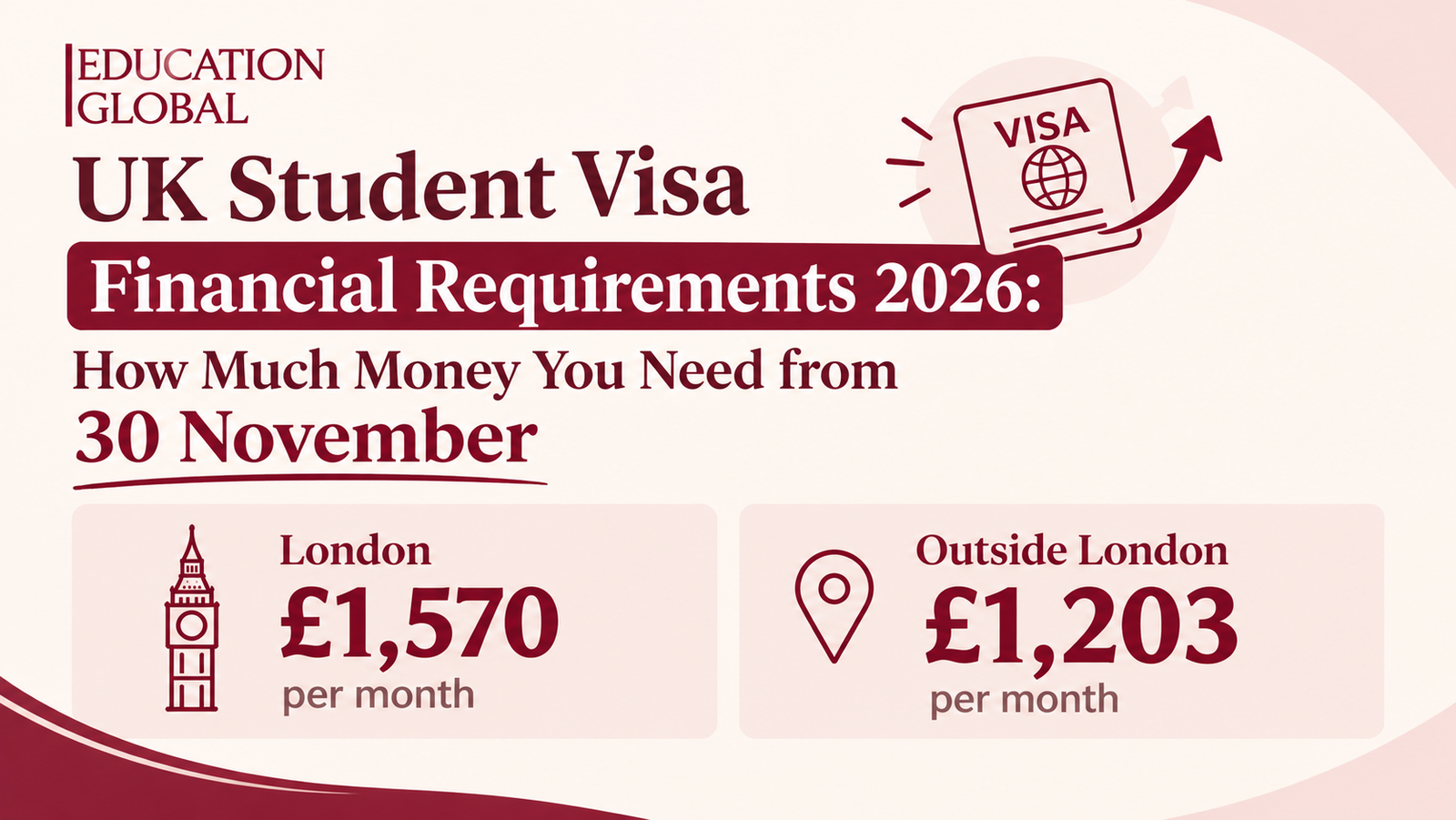
The Home Office’s Statement of Changes HC 584, laid before Parliament on 3 September 2026, raises the monthly maintenance figures. The new amounts apply to applications made on or after 30 November 2026. Applications made before that date are decided under the old figures.
| Where you study | Before 30 Nov 2026 (per month) | From 30 Nov 2026 (per month) | New 9-month maximum | Increase over 9 months |
|---|---|---|---|---|
| London | £1,529 | £1,570 | £14,130 | +£369 |
| Outside London | £1,171 | £1,203 | £10,827 | +£288 |
The maximum deduction you can make for university accommodation fees already paid also rises, from £1,529 to £1,570.
The increase keeps the international figures in line with maintenance loans available to UK home students for 2026–27. The extra amount per month is modest, but it catches students who have already set aside exactly the old total.
Does the new amount apply to me?
What matters is the date you submit your visa application, not when you received your offer or CAS.
- Applying on or before 29 November 2026: the old figures (£1,529 / £1,171) apply.
- Applying on or after 30 November 2026: the new figures (£1,570 / £1,203) apply, even if your CAS was issued earlier.
Most students starting in January 2027 will apply in November or December, so many will fall under the new rate. If you are unsure of your exact submission date, plan for the higher amount.
Who does not need to show the money?
You do not need to prove the living-cost amount if you have been living in the UK with a visa for at least 12 months on the date of application. Nationals of certain countries on the Home Office’s “differential evidence” list also do not submit financial evidence upfront, although they can be asked for it. Nepal, India, Bangladesh, Pakistan and Sri Lanka are not on that list, so students from South Asia must submit full evidence.
How much money do I need in total? A worked example
Assume a one-year master’s with £15,000 of tuition fees still owed (an illustrative figure — use the amount on your own CAS) and no accommodation fees paid in advance.
| Scenario | Fees still owed | Living costs (9 months) | Total to show |
|---|---|---|---|
| Outside London, apply before 30 Nov | £15,000 | £10,539 | £25,539 |
| Outside London, apply from 30 Nov | £15,000 | £10,827 | £25,827 |
| London, apply before 30 Nov | £15,000 | £13,761 | £28,761 |
| London, apply from 30 Nov | £15,000 | £14,130 | £29,130 |
Two things reduce the total:
- Tuition deposit paid. If you have paid part of your fees, your CAS should show it, and you only need to show the balance for the first year.
- University accommodation fees paid. Fees paid to your university for its accommodation can be deducted, up to £1,570 for applications from 30 November. Check that the payment appears on your CAS.
If your course is shorter than nine months, you need the monthly amount for each month of the course rather than the full nine.
Costs you pay on top of the funds you show
The balance above is what must sit in the account. You also pay these separately when applying:
- Visa application fee: £558 when applying from outside the UK.
- Immigration Health Surcharge (IHS): charged per year of your visa at the student rate (currently £776 a year). Use the GOV.UK calculator for your exact figure.
- TB test: required for applicants resident in certain countries, including Nepal and India, for stays over six months.
Budget for these before you move money into the account you will use as evidence, so paying them does not drop your balance below the requirement.
The 28-day rule explained
You must hold the required amount for at least 28 consecutive days, and the last day of that 28-day period must be no more than 31 days before the date you apply.
The balance must not fall below the required amount on any of those 28 days — not even for a day.
Example — applying on 7 December 2026 for a course outside London:
- You apply on 7 December, so the new rate applies.
- Your bank statement closes on 4 December — within 31 days of your application.
- Counting back, the funds must have stayed at or above the full amount every day from 7 November to 4 December inclusive.
- So the higher figure needs to be in place from early November, not just on the day you apply.
Exchange rates can push you under the line
If your money is held in Nepali rupees or another foreign currency, the Home Office converts it to pounds using the OANDA spot rate on the date of your application — not the date of your statement. A weaker rupee on that day can turn a balance that looked sufficient into one that falls short. Keep a buffer above the converted amount, and check the rate again just before you submit.
What evidence is accepted?
You can show the money through:
- Your own bank account — an account you control.
- Your parent’s or legal guardian’s account — with a letter from them confirming they agree to you using the money, plus evidence of your relationship (usually your birth certificate). Check your university’s checklist for the exact wording it expects.
- Your partner’s account — only if your partner is in the UK or applying at the same time.
- A student loan — a letter dated no more than six months before you apply, from a government, government-sponsored, or regulated academic or educational loan scheme, with no conditions on release other than your visa being granted.
- Official financial sponsorship — for example from a government or university; this is usually recorded on your CAS.
The evidence must be dated no more than 31 days before you apply and show your (or your parent’s) name, the bank’s name and the balance. Paper statements, electronic downloads, passbooks, certificates of deposit and bank letters can all be used.
What does not count
- Overdrafts
- Cryptocurrency
- Stocks, shares and pensions
- Accounts with banks that are not regulated by the financial regulator in their country
- Accounts with banks that do not keep electronic records
- Money you cannot access immediately (check the terms of any fixed-term deposit)
Tips for students applying from Nepal and South Asia
- Use a regulated bank. In Nepal, that means a bank or financial institution licensed by Nepal Rastra Bank. Ask your bank to confirm this in writing if you are unsure, and avoid relying on accounts that the Home Office may not be able to verify.
- Keep funds in one or two accounts. Spreading money across many accounts makes the 28-day check harder to evidence.
- Avoid large, unexplained deposits just before the 28-day period. The money must have been obtained legally, and the Home Office may verify it with your bank.
- Match names exactly. The name on the statement should match your passport, or your parent’s name should match your birth certificate.
- Check education loan letters carefully. A loan letter must meet the student-loan conditions above; a general bank loan approval may not.
Common mistakes that lead to refusal
- Holding the old total after 30 November.
- Letting the balance dip, even briefly, during the 28 days.
- Submitting a statement more than 31 days old.
- Forgetting that visa and IHS payments come out of the same account.
- Using a parent’s account without the consent letter or relationship evidence.
- Not allowing for currency movements.
Planning beyond the visa
Money is only one part of a strong application. If you are thinking about working in the UK after your course, note that from 1 January 2027 the Graduate visa will last 18 months, not two years, for bachelor’s and master’s graduates who apply on or after that date. PhD graduates keep three years.
Next steps
Before you move any money, confirm three things: the date you will submit your visa application, whether your university is in London, and the fees balance on your CAS. Those three answers fix the exact amount you need.
If you have questions about planning your UK study, you can contact Education Global or read more about who we are.
FAQs
How much money do I need for a UK student visa in 2026? For applications made on or after 30 November 2026: your first year’s unpaid tuition fees plus £1,570 a month in London or £1,203 a month elsewhere, for up to nine months. Before that date the monthly figures are £1,529 and £1,171.
How long does the money need to be in my bank account? At least 28 consecutive days, without dropping below the required amount. The last day of that period must be within 31 days of the date you apply.
Can I use my parents’ bank account for a UK student visa? Yes. Your parent or legal guardian must give a letter confirming you can use the money, and you will usually need your birth certificate to show the relationship.
I already have a CAS. Do the new amounts still apply to me? Yes, if you submit your visa application on or after 30 November 2026. The date of your visa application decides which figures apply, not the date your CAS was issued.
Do I need to show money for the full course? No. You show living costs for up to nine months and course fees for the first academic year only. For courses shorter than nine months, you show living costs for each month of the course.
Does the visa fee or health surcharge count towards the funds I show? No. The £558 application fee and the Immigration Health Surcharge are paid separately. Make sure paying them does not take your balance below the required amount.
Do students from Nepal need to show financial evidence? Yes. Nepal is not on the list of nationalities exempt from submitting financial evidence upfront, so Nepali applicants must include it with their application.
What happens if my balance drops below the amount for one day? The requirement is not met for that 28-day period and the application can be refused. You would need a fresh 28-day period at the correct balance before applying.
